
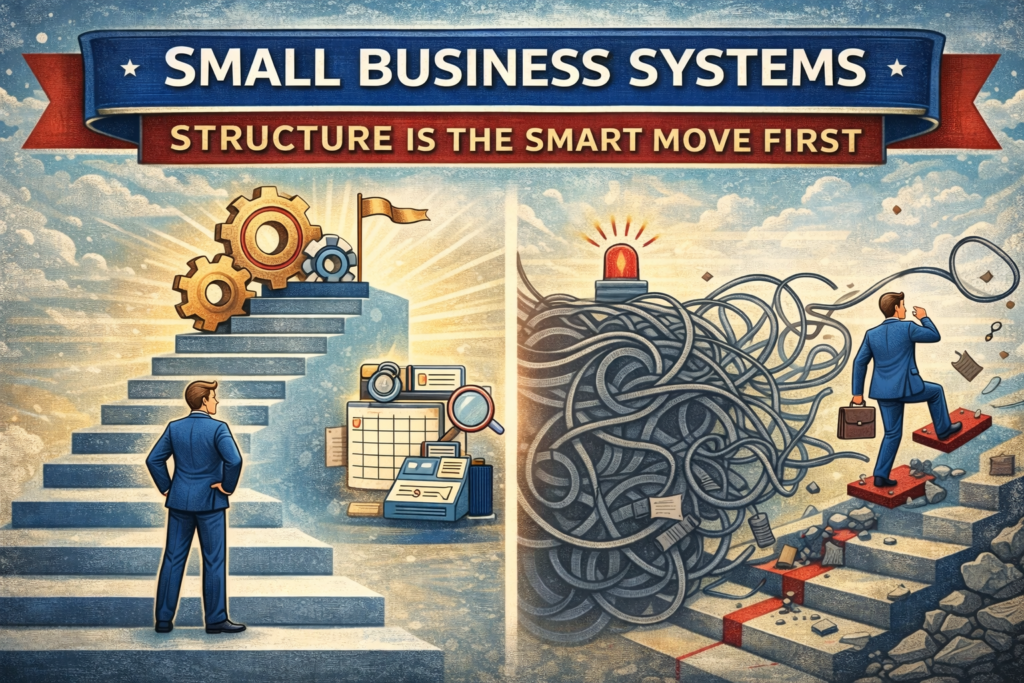
Most people who start a business believe hard work is the whole equation. And to be fair, effort matters in the early stages. You have to show up, push through the slow periods, and keep going when things feel uncertain. But if you have watched enough small businesses stall out over the years, you start noticing something they all have in common. They were busy. They just were not organized. Building small-business systems early — the repeatable processes that keep operations running without constant improvisation — is what separates companies that grow steadily from those that stay stuck in survival mode. Understanding that distinction early can change the entire trajectory of a company.
What Happens When There Is No Structure
In the beginning, most business owners wear every hat available. They handle customer inquiries, process payments, manage marketing, and try to keep everything moving at once. That approach can work for a while, and it often feels productive because something is always happening.
The problem develops quietly. Without clear processes behind all that activity, the business starts depending entirely on the owner’s daily effort to function at all. Every new customer adds workload instead of momentum. Every task gets reinvented from scratch. Growth, which should create opportunity, instead creates stress. That is usually the point at which business owners realize there is a smarter way to operate.
What Small-Business Systems Actually Mean
The word “systems” can sound technical or corporate, but the concept is straightforward. Small-business systems are simply repeatable ways of handling recurring work. They answer questions like how a new customer finds you, how an inquiry is tracked and followed up, how invoices go out, and how the business consistently delivers its service or product.
When those answers exist and are documented, the business stops relying on memory and improvisation. Things get done the same way every time, which means fewer errors, less wasted time, and a better experience for the people you serve.
Where Structure Makes the Biggest Difference
A few areas produce an immediate return when you bring some organization to them. Customer discovery is one. Every business needs a reliable way for potential customers to learn what it does, because relying on word of mouth alone rarely produces steady results. Follow-up is another. A surprising number of sales are simply lost because no one follows up, and a basic tracking method fixes that.
Financial clarity matters just as much. Understanding your revenue, your expenses, and your cash flow on a regular basis allows you to make decisions with confidence rather than anxiety. And the delivery of whatever you sell, whether a service or a product, benefits from a defined process that keeps quality consistent as you grow.
Why This Matters Even More Today
The tools available to small business owners have expanded considerably. Automation platforms, project management software, and AI-powered tools are more accessible than ever, and they can genuinely help a business operate efficiently. But they work best when there is already a clear process to support. Without structure, technology just adds another layer of complexity to manage.
When strong small business systems are already in place, those tools amplify what is working. A small company can operate with a level of consistency and professionalism that used to require a much larger team.
Thinking Like a Builder
At some point, the owners who build lasting businesses start asking a different question. Instead of “how do I get through today?” they start asking “how should this business run every day?” That shift leads to documented workflows, clear handoffs, and predictable results. Over time, the business becomes something more durable than individual effort. It becomes an operation that produces results whether the owner is working flat out or stepping back for a week.
Starting a business takes courage, and that never stops mattering. But what makes it last is usually less visible. Build the small-business systems early, before you feel you need them, and you give yourself something most business owners wish they had started with: a foundation that holds up under pressure.
