
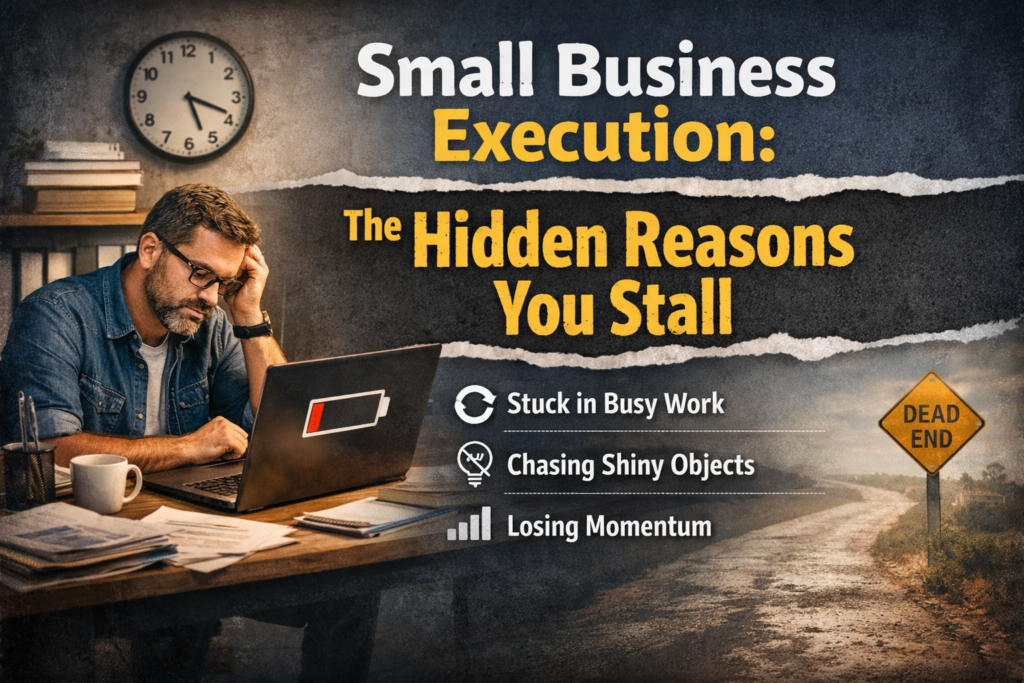
Every business reaches a point where the excitement of starting fades, and something quieter takes over. The website launches, the offer goes live, and outsiders think everything should work—but inside, progress feels uneven. It’s as if the business moves forward while standing still. This is where small business execution becomes the real story, even though most people don’t recognize it yet.
What makes this stage difficult is that nothing looks obviously broken. You’re still doing work. You’re still showing up. But the results that should follow that effort never quite line up the way you expected, and that gap is where frustration begins to set in.
Where Momentum Is Built or Lost
In the early phase, everything feels like forward motion because you are creating something that did not exist before. Decisions happen quickly, progress feels visible, and even imperfect action gives you a sense that you are moving in the right direction. That early energy carries a lot of weight, and for a while, it can mask what is actually happening underneath.
Eventually, the nature of the work changes. Instead of building, you are maintaining, refining, and repeating. The work becomes less about launching and more about operating, and this is the point at which small business execution either begins to take hold or quietly starts to break down.
This shift is subtle, but it changes everything. What used to feel like progress now feels like discipline, and many businesses aren’t ready for that shift.
The Hidden Reasons Small Business Execution Breaks Down
When a business stalls, it is rarely because of one obvious mistake. More often, it is a series of small decisions that seem reasonable in the moment but slowly pull the business away from consistent execution.
One of the most common patterns is the constant search for something new. When results do not show up quickly, it feels natural to adjust the plan, try a different platform, or rethink the offer. On the surface, that looks like adaptation, but in reality, it often resets any momentum that was beginning to build.
Another issue is inconsistency disguised as effort. There is activity, but not enough repetition for anything to take hold. A few posts are made, then a pause. A strategy is tested, then replaced before it has time to work. Without consistency, even the right actions fail to produce results.
There is also a tendency to measure effort rather than outcomes. Staying busy feels productive, but without stepping back to evaluate what is actually working, it becomes difficult to separate meaningful progress from simple motion.
None of these issues feels significant on its own, but together they quietly disrupt small-business execution and create conditions where growth slows.
Why Activity Feels Right, but Small Business Execution Feels Hard
It is easy to confuse activity with execution because both involve doing something. The difference shows up over time, not in the moment.
Activity creates movement, but that movement does not always lead anywhere. Execution, on the other hand, builds on itself. It requires repeating the same core actions long enough for them to start producing consistent results, and that repetition is where most people begin to lose patience.
Small-business execution is not as exciting as starting a business. It does not come with immediate feedback or quick wins. Instead, it works more like compounding interest, where the impact is small at first but becomes significant over time if it is allowed to continue.
Without that consistency, everything stays in motion, but nothing gains traction.
Making the Shift Into Real Small Business Execution
At some point, every business reaches a moment where continuing to build is no longer the answer. The real progress begins when the focus shifts toward operating with intention and consistency.
That shift does not require a complicated system, but it does require a change in approach. It means identifying the few actions that actually move the business forward and committing to them long enough to see results. Giving strategies time to work instead of replacing them at the first sign of slow progress. It also means paying attention to outcomes rather than just effort, which is often where the clearest insights are found.
This is where small business execution becomes a strength rather than a struggle, and it is also where businesses begin to separate themselves from those who remain stuck in constant adjustment.
Why Small Business Execution Matters More Now Than Ever
Starting a business has never been easier than it is right now. Tools are accessible, platforms are everywhere, and information is no longer a barrier. Almost anyone can get something up and running in a short amount of time.
What has become more difficult is sustaining that effort long enough to build something meaningful. The advantage no longer comes from simply starting. It comes from executing consistently in a way that allows progress to build over time.
That is why small business execution has become the real differentiator. The businesses that grow are not necessarily the ones with the best ideas, but the ones that stay focused, consistent, and patient enough to let those ideas develop.
Final Thought
Most businesses don’t stall because they miss something major. They stall because their execution weakens over time—often without realizing it—until progress slows enough to become frustrating.
Stepping back and assessing how the business operates can reveal more than any new strategy. Don’t ask whether you’re doing enough—ask whether you’re doing the right things consistently enough to matter.
That is where small business execution either begins to take shape or keeps the business in place.
Next Step
Look at your current efforts and strip them down to what actually moves your business forward. Not everything that feels productive, but the actions that directly lead to results.
Then commit to those actions consistently, even when progress feels slow, because that is when execution turns effort into outcomes.