
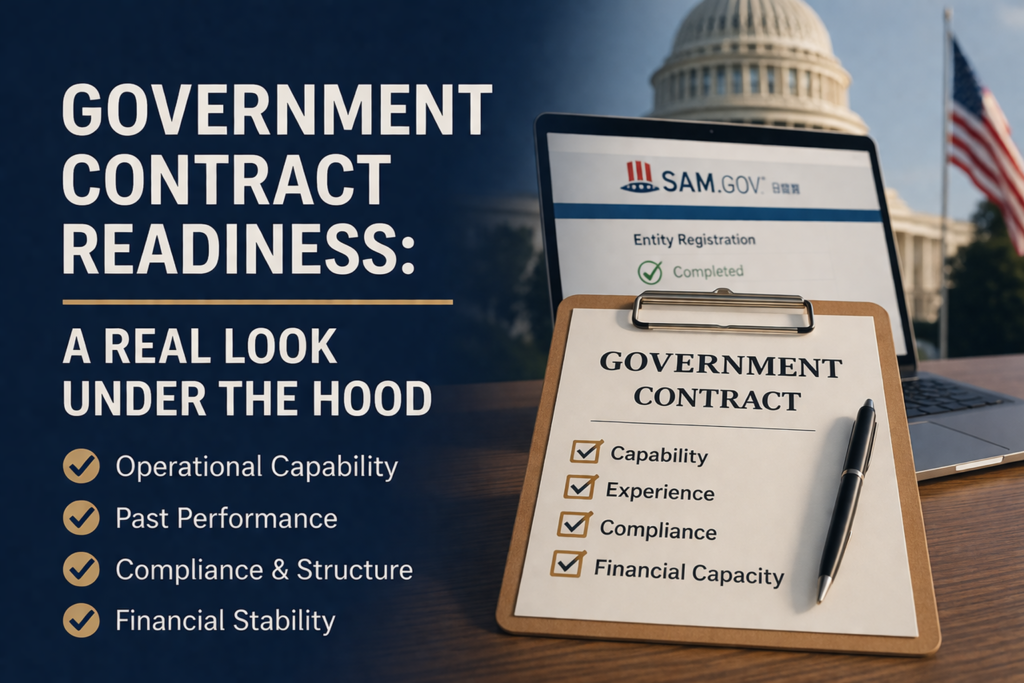
Ever notice how many companies assume government contract readiness begins the moment they register in SAM.gov?
It feels like a milestone. The paperwork is finished, the profile exists, and opportunities are starting to appear.
But inside government operations, that moment is usually just the beginning — not the signal that a company is truly prepared to compete.
This post takes a real look under the hood of government contract readiness—what it actually means, why it’s often misunderstood, and what agencies quietly evaluate before trusting a contractor with public work.
The Misleading Starting Line
Many companies enter government contracting with enthusiasm and optimism.
They complete their SAM.gov registration, begin scanning solicitations, and quickly start preparing proposals.
On the surface, it feels like progress.
But government contract readiness goes far beyond registration or paperwork. It’s about whether a company is actually positioned to perform successfully in the federal acquisition environment.
From the government’s perspective, every contract award carries risk. Agencies are responsible for taxpayer funds and mission delivery, so they must evaluate whether a contractor can realistically deliver on its promises.
That evaluation begins long before an award decision is made.
What Government Contract Readiness Really Means
Government contract readiness is the condition in which a company has the operational capability, experience, financial stability, and administrative structure necessary to compete for and perform government contracts.
In simple terms, it answers a straightforward question:
If the government awarded this contract tomorrow, could the company actually deliver?
That question drives much of the evaluation process.
Capability Matters More Than Interest
Interest in government contracting is easy to find. Capability is what agencies measure.
A company pursuing government work should have a clear understanding of its core strengths and how those strengths align with specific government requirements.
That includes practical considerations such as:
- The size and scope of projects the company can support
- The geographic areas where services can realistically be delivered
- The depth of available staffing and subject matter expertise
- Operational systems capable of supporting contract performance
When companies stretch beyond those realities, it often becomes visible during proposal evaluations.
Experience Builds Confidence
Past performance remains one of the most powerful indicators of future success.
Government agencies want to see evidence that a company has successfully completed work similar to the request.
That experience does not always need to come from federal contracts. It can include:
- Commercial work with comparable complexity
- State or local government contracts
- Subcontracting roles supporting established prime contractors
What matters is demonstrating that the organization understands the type of work involved and has delivered results before.
The Administrative Side of Contracting
Government contracts operate within a highly structured regulatory environment.
Companies that primarily operate in commercial markets are often surprised by the level of compliance required.
Common areas include:
- Federal Acquisition Regulation (FAR) clauses
- Labor category and wage requirements
- Reporting obligations
- Security or cybersecurity standards
Organizations that prepare for these requirements early avoid significant challenges later.
Financial Readiness Often Gets Overlooked
Another element of government contract readiness involves financial capacity.
Some contracts require companies to:
- Hire staff before payment begins
- Purchase equipment or materials in advance
- Carry payroll while awaiting government payment cycles
Without adequate financial stability, even a well-won contract can become difficult to execute.
Why Companies Skip This Evaluation
Many solicitations look promising when viewed from the outside.
Contract values can appear significant, and the opportunity to work with the federal government carries a sense of prestige.
That excitement sometimes leads companies to move directly into proposal development without pausing to evaluate whether the opportunity truly fits their capabilities.
Instead of asking “Are we ready to perform?”, the focus becomes “Can we win?”
Inside the acquisition process, those two questions are closely connected.
The Cost of Skipping Readiness
Preparing a government proposal is rarely a small effort.
A single submission may require contributions from technical experts, pricing specialists, managers, and compliance reviewers.
In many cases, companies invest dozens or even hundreds of hours preparing a single proposal.
If the underlying readiness is not there, that effort rarely produces results.
Over time, repeated unsuccessful pursuits can drain both time and internal momentum.
The Contractors Who Succeed Think Differently
Experienced government contractors tend to approach opportunities more selectively.
Rather than chasing every solicitation that appears, they carefully evaluate whether an opportunity aligns with their capabilities, experience, and long-term strategy.
Sometimes the most strategic decision is simply choosing not to pursue.
That discipline often separates companies that build sustainable government contracting businesses from those that burn out early in the process.
Final Thought
Government contracting offers meaningful opportunities for companies that approach it with a clear strategy and preparation.
But real success rarely begins with writing proposals.
It begins with an honest look at government contract readiness — the operational, financial, and organizational foundation required to perform successfully.
Before investing significant time preparing a bid, companies should pause and ask one practical question:
Are we truly ready for the responsibility that comes with the contract?
